Right Drive Academy – Birmingham Driving School & Driving Lessons
  • Home
  • About Us
  • Driving Lesson Prices
  • How to Get Your UK Driving Licence: Complete Step‑by‑Step Guide
  • Contact
  • Blog

Driving School Blog – Tips, Guides and Updates
Picture

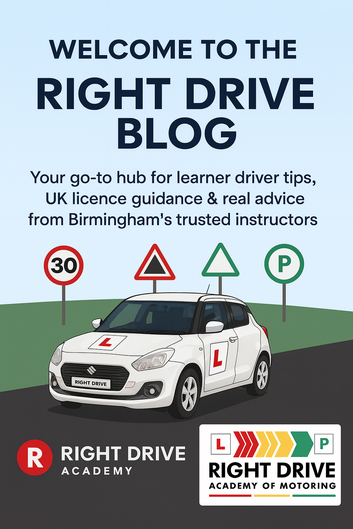
Welcome to the Right Drive Blog --
​
your go‑to hub for learner driver tips, UK licence guidance, and real advice from Birmingham’s trusted instructors.


Whether you’re applying for your provisional, revising for your theory test, preparing for your practical, or just starting your driving journey, this blog breaks everything down in a simple, clear, and up‑to‑date way.
We share expert insights, common mistakes to avoid, test‑day guidance, and real learner experiences to help you feel confident every step of the way.
​
Stay tuned, stay informed, and level up your driving knowledge with Right Drive Academy of Motoring.
□ Call Now □ Book Lesson

Driving Test Preparation: What to Do, What to Avoid, and What to Bring on the Day

31/1/2026

0 Comments

 
Picture
Preparing for your driving test can feel overwhelming, but with the right approach, you can walk into the test centre feeling confident, calm, and ready to pass. Whether you’re taking your test soon or planning ahead, this guide covers the essential do’s, don’ts, and must‑bring items to help you succeed.


⭐ Why Good Preparation Matters
Most learners fail not because they can’t drive — but because nerves, poor planning, or simple mistakes get in the way. Understanding what to expect and preparing properly can make a huge difference to your performance on the day.

✔️ What to Do Before Your Driving Test
1. Practise Consistently
Regular practice builds confidence. Focus on:
  • Manoeuvres (parallel park, bay park, pull‑up on the right)
  • Roundabouts and junctions
  • Speed control and mirror checks
  • Independent driving
2. Take a Final Lesson
A pre‑test lesson helps you warm up, settle nerves, and iron out any last‑minute issues. Many instructors recommend a 1–2 hour session before the test.
3. Know the Test Area
Familiarise yourself with:
  • Local roundabouts
  • Busy junctions
  • Speed limit changes
  • Common test routes (if available)
4. Prepare Mentally
  • Get a good night’s sleep
  • Eat something light
  • Visualise a calm, steady drive
  • Remind yourself that the examiner wants you to pass
5. Plan Your Journey
Arrive 10–15 minutes early. Rushing increases stress and affects performance.

❌ What NOT to Do Before Your Driving Test
1. Don’t Cram
Trying to learn new manoeuvres the night before only increases anxiety. Stick to what you already know.
2. Don’t Listen to “Test Horror Stories”
Everyone’s experience is different. Focus on your own driving, not someone else’s drama.
3. Don’t Skip Meals
Low energy = poor concentration. Eat something light and steady.
4. Don’t Overthink Mistakes
If you make a small error during the test, keep going. Many learners pass even with minor faults.
5. Don’t Arrive Late
Being rushed is one of the biggest causes of test‑day nerves.


🎒 What You MUST Bring on Test Day
To avoid last‑minute panic, prepare these items the night before:

Essential Documents
  • Provisional driving licence - no license!!!! no test!!!!

  • Your instructor’s car or a car that meets DVSA standards

  • Theory test pass certificate (if required) - I've only ever seen it be requested once in 20+ years and that's because candidate did her theory test in Northern Ireland
Personal Items
  • Glasses or contact lenses (if you need them for driving)
  • Water bottle
  • Any medical items you require (e.g., inhaler)
Optional but Helpful
  • A light snack
  • A small towel or tissues (sweaty hands are normal!)
  • A phone charger (for after the test)


🚘 On the Day: How to Stay Calm and Focused
1. Treat It Like a Normal Lesson
The test is simply a drive with someone new in the passenger seat.
2. Listen Carefully
Examiners give clear instructions. If you’re unsure, you can ask them to repeat.
3. Drive Safely, Not Perfectly
The test isn’t about perfection — it’s about safe, consistent driving.
4. Don’t Rush
Take your time at junctions, roundabouts, and when parking.
5. Keep Breathing
Deep, slow breaths help reduce tension and improve focus.

🎉 Final Thoughts: You’re More Ready Than You Think
Passing your driving test is a milestone — and with the right preparation, you can absolutely do it. Stay calm, trust your training, and remember that every driver on the road today once sat exactly where you are now.
If you’re still feeling unsure, booking a mock test or an extra lesson can give you the confidence boost you need. You got this - now go get that license!
BOOK NOW
0 Comments

How to Stay Calm Behind the Wheel: A Practical Guide for Nervous Learner Drivers.

21/1/2026

0 Comments

 
Picture
Feeling nervous during driving lessons or on test day is completely normal. In fact, most learners experience some level of anxiety — even the ones who look confident from the outside. At Right Drive Academy of Motoring, we see nerves every day, and we help learners turn that anxiety into calm, controlled confidence.
This guide breaks down why nerves happen, how to manage them, and the simple habits that make a huge difference on the road.


Why Do Learners Get Nervous? 
Nerves usually come from:
  • Fear of making mistakes
  • Worrying about being judged
  • Pressure to pass quickly
  • Overthinking every movement
  • A bad experience with a previous instructor
The good news? Every one of these can be managed with the right mindset and support.

1. Focus on Progress, Not Perfection
Driving is a skill built step by step. You’re not meant to know everything on day one. A calm learner is one who understands:
  • Mistakes are part of learning
  • Every lesson builds confidence
  • You only need to be safe, not perfect
When you shift your mindset from “I must get everything right” to “I’m improving each time,” your nerves naturally settle.

2. Control Your Breathing Before You Drive
A simple breathing routine can reset your entire body:
  • Inhale for 4 seconds
  • Hold for 2
  • Exhale for 6
This slows your heart rate and clears your mind. Many of our learners use this technique right before starting the engine.

3. Break the Drive Into Small Sections
Instead of thinking about the whole lesson or the whole test, focus on:
  • The next junction
  • The next mirror check
  • The next manoeuvre
Small steps keep your brain calm and prevent overwhelm.

4. Talk Through What You’re Doing
This is a powerful technique:
  • Say out loud: “Mirror, signal, manoeuvre.”
  • Say: “I’m checking my left mirror before moving off.”
It keeps your mind focused on the present moment instead of worrying about what might go wrong.

5. Choose an Instructor Who Makes You Feel Safe
A calm instructor creates calm learners. At Right Drive Academy, we focus on:
  • Clear explanations
  • Zero judgement
  • A relaxed teaching style
  • Step‑by‑step confidence building
When you feel supported, your nerves naturally reduce.

6. Prepare for Test Day Like an Athlete
Confidence comes from preparation:
  • Get a good night’s sleep
  • Eat something light
  • Arrive early
  • Do a short warm‑up drive
Treat test day like a performance — not a punishment.
​
7. Accept That Nerves Are Normal
Even confident drivers feel butterflies. The goal isn’t to eliminate nerves — it’s to manage them. A little adrenaline can actually sharpen your focus.

Final Message to Learners
If you’re nervous, you’re not alone. You’re not behind. You’re not “bad at driving.” You’re simply learning something new — and that takes time, patience, and the right support.
At Right Drive Academy of Motoring, we specialise in helping nervous learners become calm, confident, and test‑ready. With the right guidance, you’ll surprise yourself with how quickly your confidence grows.
BOOK NOW
0 Comments

5 Things Every New Learner Should Do Before Their First Driving Lesson

20/1/2026

0 Comments

 
Picture

Starting driving lessons is a big milestone, and for many learners in Birmingham, the first session can feel exciting and a little nerve‑wracking. A bit of preparation goes a long way. Whether you’re learning in Bordesley Green, Small Heath, Sparkhill, Great Barr, Kingstanding, or anywhere across the city, these simple steps will help you get the most out of your very first lesson.

1. Bring Your Provisional Licence
Your instructor legally needs to see your provisional licence before you can get behind the wheel. Make sure it’s:
  • Valid and in date
  • The physical card (not just a photo)
  • Easy to access on the day
If you’ve recently applied, double‑check it has arrived before booking your first lesson.

2. Wear Comfortable Clothing and Suitable Footwear
Driving requires smooth pedal control, so what you wear matters more than people think.
Choose:
  • Flat, thin‑soled shoes
  • Comfortable clothing that doesn’t restrict movement
    Avoid:
  • Heavy boots
  • High heels
  • Bulky jackets
You’ll feel more relaxed and in control from the moment you start.

3. Get Familiar With the Car Basics
You don’t need to know everything — that’s what lessons are for — but a little awareness helps you settle in quicker. Before your first session, take a moment to understand:
  • What the pedals do
  • The difference between “Drive”, “Park”, and “Neutral” (for automatic learners)
  • Basic dashboard symbols
This small bit of prep boosts confidence massively.

4. Bring Any Glasses or Contact Lenses You Need
You’ll be asked to read a number plate from 20 metres away. If you normally wear glasses or contacts, make sure you have them with you.
Good vision isn’t just a legal requirement — it helps you feel safer and more aware on the road.

5. Relax and Keep an Open Mind
Your first lesson isn’t a test. It’s an introduction.
You’ll learn:
  • How to set up the car
  • How to move off safely
  • How to steer with control
  • How to stop smoothly
Every learner starts at a different level. Your instructor’s job is to guide you, support you, and build your confidence step by step.

Final Thoughts
Preparing for your first driving lesson doesn’t need to be complicated. A few simple steps help you feel calm, confident, and ready to learn. At Right Drive Academy of Motoring, we make sure every learner feels supported from day one — whether it’s your first time in the driver’s seat or you’re returning after a break
0 Comments

10 Reasons Learners Fail Their UK Driving Test — and How to Avoid Them

19/1/2026

0 Comments

 
Picture
10 Reasons Learners Fail Their UK Driving Test — and How to Avoid Them
Passing your driving test is a massive milestone, but more than half of learners don’t pass on their first attempt. The good news is that most mistakes are completely avoidable with the right guidance.
This guide breaks down the most common reasons learners fail — and how you can stay one step ahead.


1. Poor Observation at Junctions
One of the biggest reasons for test fails. Learners often pull out too early or don’t check properly.
Tip: Slow down, look both ways, and only move when it’s 100% safe.


2. Not Using Mirrors Correctly
Forgetting to check mirrors before turning, changing lanes, or slowing down.
Tip: Make mirror checks part of your natural driving rhythm.


3. Incorrect Road Positioning
Drifting too close to parked cars or not staying centred in your lane.
Tip: Keep a steady position and constantly scan the road ahead.


4. Missing or Misreading Road Signs
Speed limits, stop signs, lane arrows — learners often miss them under pressure.
Tip: Keep your eyes moving and read the road early.


5. Poor Steering Control
Oversteering, understeering, or taking corners too wide.
Tip: Keep your hands steady and guide the wheel smoothly.


6. Moving Off Unsafely
Not checking blind spots or signalling properly before moving.
Tip: Mirrors → Signal → Shoulder check → Move.


7. Incorrect Use of Signals
Late signals, no signals, or misleading signals.
Tip: Signal early, clearly, and only when needed.


8. Driving Too Fast or Too Slow
Both can cause a fail.
Tip: Match your speed to the road, traffic, and conditions.


9. Not Responding to Road Markings
Box junctions, lane guides, stop lines — learners often miss them.
Tip: Look ahead and plan your position early.


10. Stalling or Poor Clutch Control
Especially at roundabouts, junctions, and hill starts.
Tip: Practice clutch balance and stay calm if you stall.


How to Avoid These Mistakes
  • Take regular lessons with a qualified instructor
  • Ask for honest feedback after every session
  • Do mock tests to build confidence
  • Stay calm and focused on test day
  • Remember: the examiner wants you to pass


Final Word from Right Drive Academy
Every learner makes mistakes — but knowing what to expect helps you prepare smarter. At Right Drive Academy, we guide you from provisional to pass with real advice, local knowledge, and patient instruction.
📍 Birmingham-based
📲 Book your lessons today
🔗 Visit our Learner Guide for more support
0 Comments

    Author

    Sameer Hussein

    ​BSC (hons)
    ADI (20+ Years)
    Owner Right Drive Academy of Motoring
    ​

    Archives

    February 2026
    January 2026

    Categories

    All

    RSS Feed

Site powered by Weebly. Managed by Bluehost
  • Home
  • About Us
  • Driving Lesson Prices
  • How to Get Your UK Driving Licence: Complete Step‑by‑Step Guide
  • Contact
  • Blog